Rights-based approach to drugs and HIV mandatory

Request for Proposals (RFP): Pilot HIV Intervention Programme Targeting Men who Have Sex with Men (MSM) in Malaysia
June 23, 2014Empowering Safety Programme – A Medical Latex (DUA) and MAC collaboration to spread safer sex awareness
July 3, 2014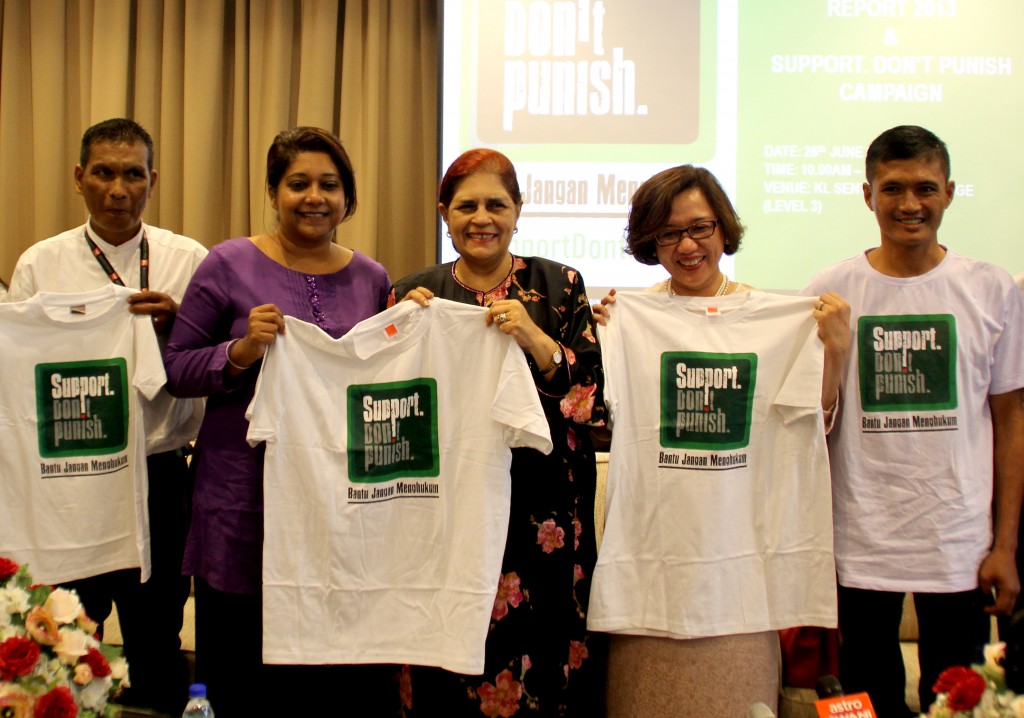
RIGHTS-BASED APPROACH TO DRUGS AND HIV MANDATORY
Malaysian AIDS Council (MAC) HIV & Human Rights Mitigation Report 2013 released in conjunction with Support. Don’t Punish. campaign evokes grave concern over cases of HIV discrimination
_____________________________________________________________
KUALA LUMPUR, 26 June 2014 – Protection of basic human rights to health for society’s most vulnerable and marginalised remains the cornerstone of a successful HIV and drug policy, emphasised Malaysian AIDS Council (MAC) at a press conference today to release its HIV & Human Rights Mitigation Report 2013 in conjunction with the United Nations’ International Day against Drug Abuse and Illicit Trafficking.
The HIV & Human Rights Mitigation Report 2013, made possible through the European Union Asia Action grant, describes 17 cases of HIV associated discrimination that were reported to MAC in the past year involving instances of arbitrary arrests of drug users by law enforcement officers, deprivation of access to antiretroviral and other essential medicines in custodial settings and students’ diplomas being withheld on account of their HIV positive status, among others.
“We are deeply concerned by these discriminatory cases as they directly reflect the extent of stigma against people living with HIV that is still prevalent in Malaysia. We are also dismayed to learn that key affected populations especially people who use drugs continue to be the target of harassment by law enforcement entities. We remain committed to addressing discriminatory practices and structural barriers that impede access to HIV treatment, harm reduction and other public health services and will continue to form strategic partnerships with the relevant authorities and Government agencies to improve the situation,” explained MAC President Datuk Dr. Raj Karim.
The full report is available online from MAC website via:
Meanwhile, the press event also saw the launch of the Support. Don’t Punish. campaign, a global advocacy initiative to raise awareness of the harms caused by the criminalisation of people who use drugs and promote a more effective and humane approach to drugs that is based on public health and human rights. This was marked by a presentation on the latest findings of HIV and drug related research in Malaysia, delivered by Prof. Dr. Adeeba Kamarulzaman, Dean of the Faculty of Medicine, University of Malaya who also heads the operations of the Centre of Excellence for Research in AIDS (CERiA), Malaysia’s sole HIV & AIDS dedicated research centre.
“Studies conducted by CERiA prove that harm reduction services such as the needle and syringe exchange programme and methadone maintenance therapy have successfully averted over 12,653 new HIV infections since 2006, which have yielded savings of RM47.1 million in direct health costs for the Government. Another recent study on the National Anti-Drugs Agency (AADK) Cure & Care Centres revealed that more than 72 per cent of the people who use drugs receiving methadone treatment there improved their family relations, obtained permanent homes and stayed out of prisons. In the face of such strong scientific evidence, we cannot in good conscience continue applying harmful drug laws and punitive measures that have only fueled health crises and devastated lives. We simply must reform our approach,” said Prof. Adeeba.
Support. Don’t Punish. is organised by a coalition of over 100 NGOs around the world. In Malaysia, the campaign is led by MAC. A series of events was held throughout the entire day in various parts of the Kuala Lumpur city centre to improve the awareness of the public on the effectiveness of harm reduction and rights-based approach to drug issues, such as a mobile exhibition and dissemination of flyers and posters.
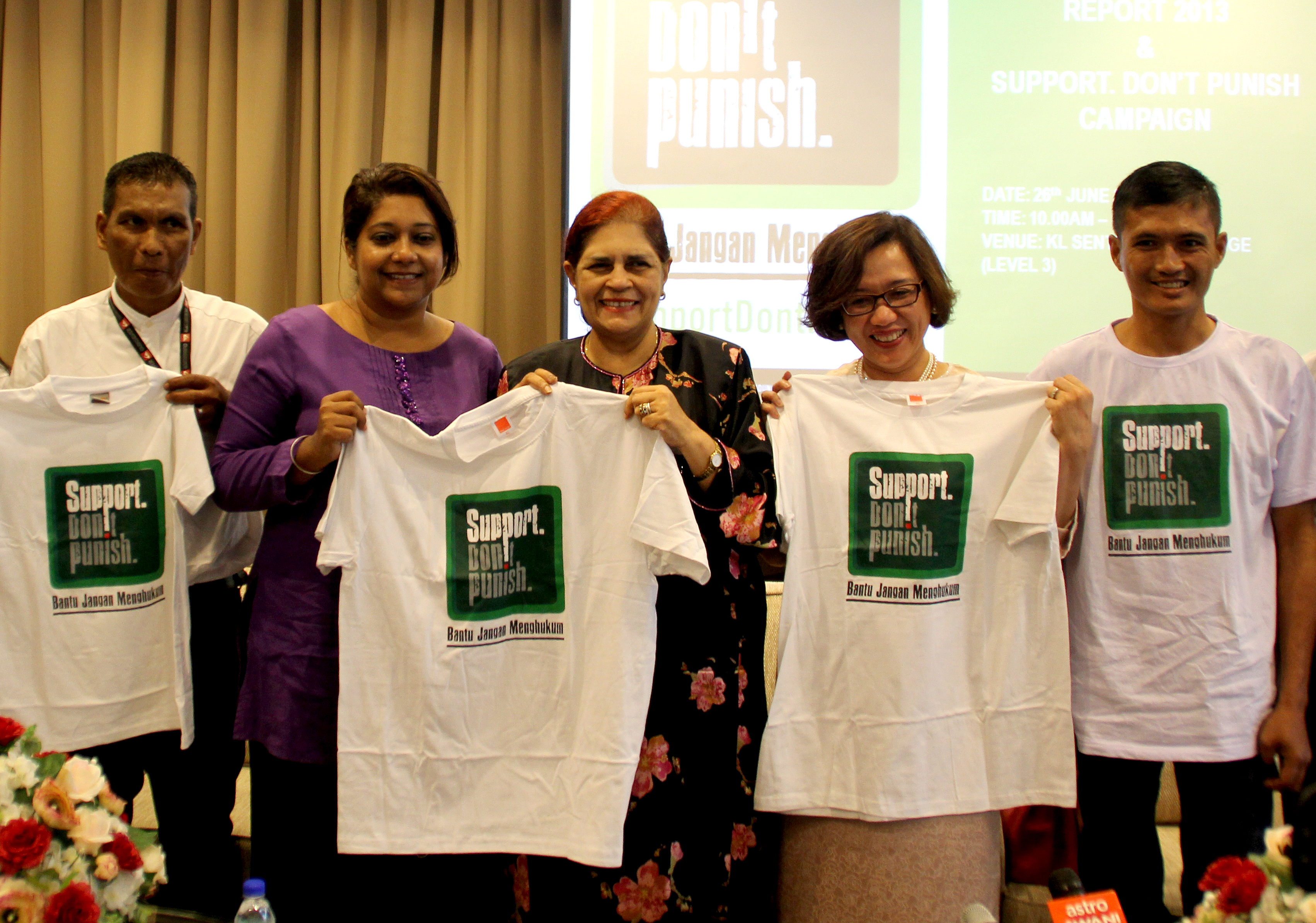
Speakers at the press conference on the launch of the Support. Don’t Punish. Global Day of Action, held on 26 June 2014 in Kuala Lumpur, holding the Malaysian customised campaign t-shirts in support of improving access to treatment for and ending criminalisation of people who use drugs.
From left: Hazizan Hassan, Peer Educator, Cure & Care Service Centre Kerinchi, National Anti-Drugs Agency (AADK); Dr. Sangeeth Kaur, Principal Assistant Director, Treatment, Medical Care and Rehabilitation Division, AADK; Datuk Dr. Raj Karim, President, Malaysian AIDS Council; Prof. Dr. Adeeba Kamarulzaman, Dean of Faculty of Medicine, University of Malaya; and Hamdan Isnin, representative of the community of people who use drugs.
[END]
Malaysian AIDS Council
The Malaysian AIDS Council (MAC) was established in 1992 to serve as an umbrella organisation to support and coordinate the efforts of non-governmental organisations (NGOs) working on HIV & AIDS issues in Malaysia. MAC works in close partnership with government agencies, the private sector and international organisations, to ensure a committed and effective NGO-led response to the HIV epidemic. In addition to providing nationwide coverage of HIV prevention, treatment, care and support services, MAC and its Partner Organisations serve as the common voice for communities most affected by HIV & AIDS in the country. Learn more at www.mac.org.my
Support. Don’t Punish.: Join the conversation
Stand with us in support of improving access to treatment for and ending persecution of people who use drugs! Share the campaign message widely among your friends and contacts, using the Twitter hashtag #supportdontpunish or tweet @SDPcampaign
Contact
Media & Communications Department, Malaysian AIDS Council
Zaki Arzmi │ +6016 2922 948 │ [email protected]
Meera Abi │ +6016 4146 400 │ [email protected]